Insider Series: From Chokepoints to Checkpoints: Oil and the New Indo-Pacific Order
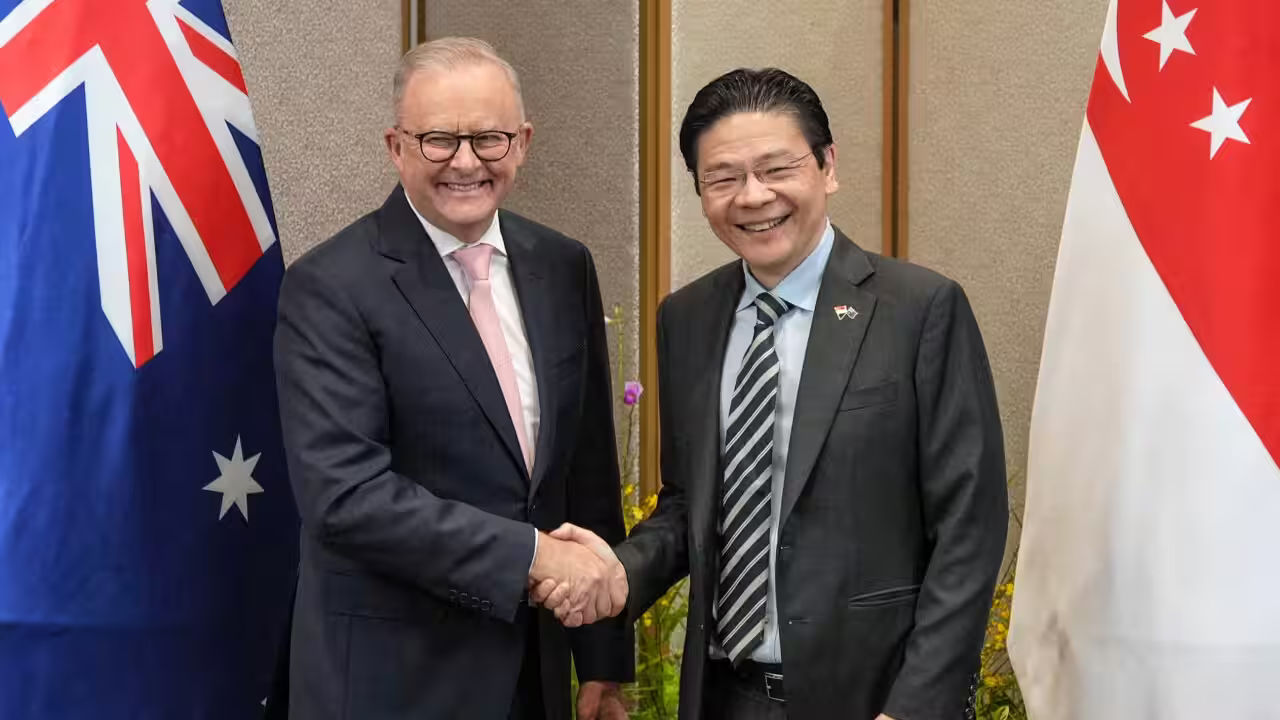
Australia and Singapore to boost energy relations during an era of oil shortages. Source: AFP / LianHe Zaobao / Chia Ti Yan
Fuel crises historically have always made states wary of unrest. Fuel issues have overthrown governments, impacted national economies and even resulted in conflicts. Yet in the Indo-Pacific region, the ongoing oil crisis is doing something more than this. In addition to generating instability, the fuel shortage is slowly bringing countries closer together.
The ongoing crisis is anything but abstract. The rise in tensions between the US and Iran has once again made people think about the Strait of Hormuz, which remains one of the key energy chokepoints in the region. Around one-fifth of the world's oil trade takes place in the Strait. With tensions arising from the increased presence of naval fleets, the threat of seizure of vessels and other risks involved, there are concerns that the free passage of oil will be disturbed. Even the possibility of a total shutdown of the Strait has already caused price volatilities. The effects for Indo-Pacific countries that rely mostly on Middle Eastern energy are immediate.
It is no secret that energy insecurity has played a major role in shaping geopolitics in the region. The so-called 'Malacca dilemma' of China, the reliance on sea routes vulnerable to disruption during a crisis, explains China's aggressiveness in the South China Sea and attempts to develop alternative ways to transport oil. The simple logic is that if the access to energy supplies is threatened, the state should seek to control them.
However, in the context of the current crisis, the problem becomes more complex and interesting. The volatility of the market, coupled with the lack of certainty about the stability of the supplies, forces states not only to compete, but also build closer relations to ensure stable energy inflow. Energy insecurity results in greater interdependence.
Australia is one of the few countries in the region that is not facing the problem of finding energy suppliers. It is a steady provider of energy, which allows it to use its export opportunities to establish more extensive cooperation. This is especially vivid with respect to the relationship between Australia and Singapore, which recently has entered a new level of cooperation in the form of the Australia-Singapore Comprehensive Strategic Partnership. In the context of energy security, this means that Singapore, as the country heavily dependent on imported energy, seeks stable suppliers, whereas Australia uses Singapore's demands for establishing military cooperation and coordination of actions during potential emergencies.
Similar trends can be observed in relations between Australia and Japan, which for many decades has been receiving 40 per cent of the total amount of LNG produced in Australia. Japan's demand for reliable oil and gas suppliers helps cement a strategic relationship, which also manifests itself in reciprocal defence agreements like Reciprocal Access Agreement or joint defence exercises and operations. Energy security plays an integral part in building up trust that leads to military cooperation.
-
Gain a remote international experience with leading experts in international relations at The Global Campus. As a student organisation we pride ourselves in our key values of engagement, empathy and education. To share a non-biased interpretation of geopolitics and international relations news, become a platform that provides equal educational opportunities by connecting esteemed professors and organisations with students around the world, and to build a global network of individuals, sharing cultures and perspectives through unique events and forums.
See below to fit your interests and become apart of our journey!
-
Type: Remote, Volunteer
Duration: 6 months
Job Description:
The Global Campus (TGC) is a student-led international organisation focused on promoting informed, independent thinking on global affairs. We connect students, academics and organisations worldwide through non-biased news, accessible education and cross-cultural engagement.
Engagement Ambassadors represent TGC within their country or region. You’ll contribute to our weekly geopolitics newsletter, help expand our global network, and promote TGC initiatives to student communities in your area.
Our ambassadors at TGC are diligent, curious and passionate about international affairs. This role will require you to be the face for TGC, representing your respective country under the guidance of your national ambassador. Understanding and promoting our vision, and networking with others is key for a successful ambassador.
Engagement Ambassadors are free and independent thinkers, helping others to do the same. By contributing to the non-biased newsletter on a weekly basis and networking with students they are key to the vision of TGC.
Key Responsibilities
Contribute one fact-based news update per weekday to the TGC geopolitics newsletter.
Write with an interest of choice or general geopolitics news given the news is facts based and non-biased.
Coordinate with other contributors to avoid overlap.
Track developments in your chosen region or thematic area (eg. East Asia, conflict studies, climate, African politics).
Promote TGC events and initiatives to student communities in your region.
Build networks with students, academics and relevant organisations.
Reposting the newsletter once a week on your socials.
Ideal candidates:
Understand the vision of TGC.
Previous writing or journalism experience is welcomed but not required.
Are able to contribute to the newsletter in adherence with the weekly contribution schedule.
Able to commit 4–6 hours per week.
Are able to produce fact-based, concise writing in English.
Have a strong interest for international relations and cooperation.
Interviews will be held via zoom. To apply, send your resume and cover letter (optional) to info@the-global-campus.com.
-
Type: Remote, Volunteer
Duration: 6 months
Job Description:
The Global Campus (TGC) is a student-led international organisation focused on promoting informed, independent thinking on global affairs. We connect students, academics and organisations worldwide through non-biased news, accessible education and cross-cultural engagement.
Empathy Ambassadors represent TGC within their country or region. As an empathy ambassador you will organise and host biweekly events that showcases a specific culture through The Global Campus. What is means to be a part of the empathy team here at The Global Campus is to present cultural insights respectfully, that encourages dialogue, avoids stereotypes and ensures diverse perspectives.
Our ambassadors at TGC are diligent, curious and passionate about international affairs. This role will require you to be the face for TGC, representing your respective country under the guidance of your national ambassador. Understanding and promoting our vision, networking with others and enhancing cross-cultural dialogue is key for a successful ambassador.
Key Responsibilities
Collaborating with other empathy ambassadors to design, organise and host a cultural event every two weeks.
Hosting a zoom session for 20-100 attendees.
Preparing slides, discussion points or curated content.
Promote TGC events and initiatives to student communities in your region.
Researching cultural topics.
Hosting Q&A and cross cultural dialogue.
Reposting the newsletter once a week on your socials.
Ideal candidates:
Understand the vision of TGC.
Are confident in their hosting experience.
Reliable over a 6-month period.
Have demonstrated cross-cultural communication.
Are able to present their findings (or own culture) through The Global Campus in adherence with the biweekly schedule.
Able to commit 4–6 hours per week.
Have a strong interest for international relations and cooperation.
Interviews will be held via zoom. To apply, send your resume and cover letter (optional) to info@the-global-campus.com.
Finally, the case of India needs to be mentioned, as India becomes increasingly interested in diversified sources of oil due to its status as the largest oil importer in the world. In this case, Australia's involvement in Indian oil markets and its efforts to provide stable supplies are being rewarded with military cooperation and joint security efforts.
All the described aspects are supported by the involvement of the wider regional community in the matter. Quadrilateral Security Dialogue pays considerable attention to cooperation in energy security, which may not be apparent at first glance, given the focus on military and naval cooperation. AUKUS can also play an important role here by contributing to the establishment of a more robust strategy that would take into account the issue of securing energy supplies and developing resilient infrastructure.
All things considered, we are witnessing the emergence of a new trend, according to which energy can serve as a means of political influence. Australia's status as a reliable energy provider gives it additional leverage to establish cooperation with other states and expand its influence.
Of course, not everyone is convinced that these relations are inherently stabilising. Quite the opposite, they are likely to further aggravate geopolitical tensions, especially considering the rising influence of China. The increasing attempts to diversify energy sources and ensure their supply through non-contested routes are likely to result in the increase in strategic competition in the future.
Nevertheless, the deeper the connections get, the more difficult it gets to view each other as enemies. Long-term energy arrangements, infrastructure and strategic cooperation create barriers to disruption, which increases costs of any possible action. Interdependence itself becomes a mechanism of prevention of potential conflicts.
Australia, in particular, finds itself in an advantageous position with regard to this trend, as it can benefit from its status of a reliable energy source to establish cooperation within Indo-Pacific countries. It finds itself involved in a process of geopolitical competition, yet it is no longer just an oil importer or exporter.
Thus, the Indo-Pacific region enters a period when competition and cooperation go hand in hand, complementing each other. The recent events in the Strait of Hormuz show how unstable the current situation is and how much work there is to do. However, they also demonstrate how the states try to cope with the challenge by creating more connections.
